Tell us about the job
Takes about a minute. No obligation.
A heat pump installation in St. Johns County starts with a sizing question that has a local answer. 194 severe weather events were recorded in St. Johns County, Florida between 2015 and 2024. At that rate, severe weather is a regular part of what every system in this area runs against, not an occasional outlier. A contractor quoting an install has to size the equipment for a climate that pushes it hard on a routine basis, and undersizing because a catalog spec looks close enough is how a system ends up short-cycling through its first few summers. The quality of the install itself carries similar weight: refrigerant line routing, electrical connections and mounting all behave differently under sustained weather load than they do in a milder place.
Ductwork and electrical panels in St. Johns County houses were sized and routed for systems close in demand to a modern heat pump, which is a different starting point than a house that predates the technology by a generation or more. Half the homes in St. Johns County, Florida were built in 2004 or earlier (2020-2024 ACS 5-year). That puts the real variables of a heat pump installation on the equipment side and the load calculations, not on what is already in the walls. A contractor who opens the electrical panel in a house of this vintage is checking, not excavating.
What Gets Installed With a New Heat Pump
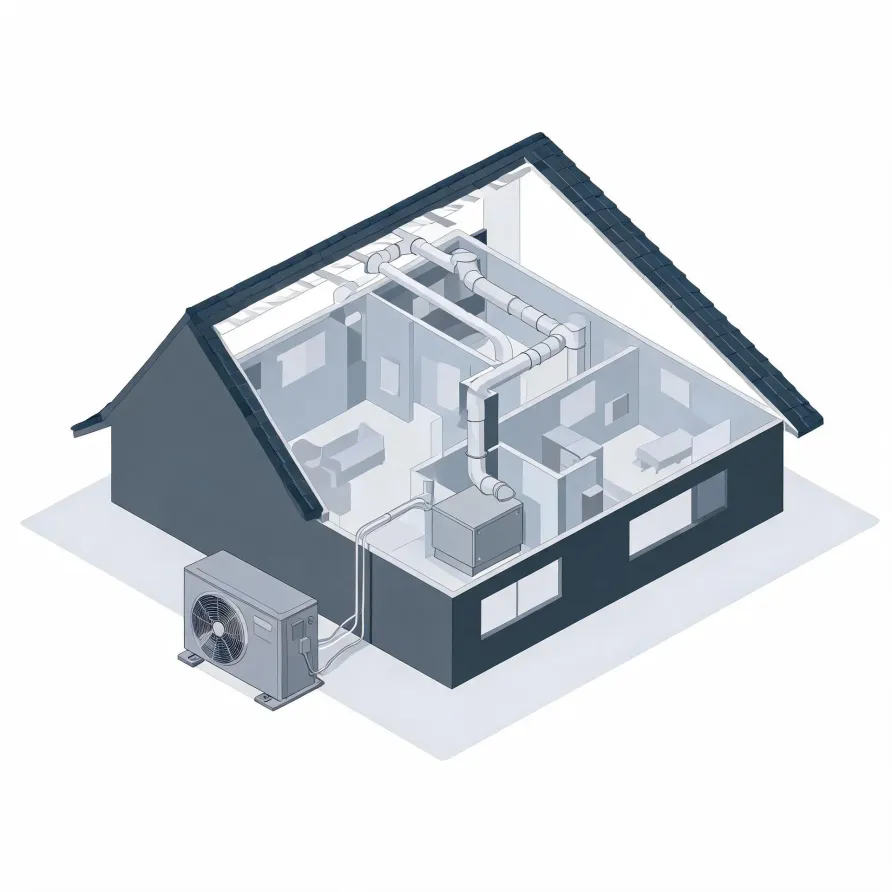
The outdoor unit is the piece a homeowner sees first, mounted on a concrete pad beside the house. It holds the compressor and the condenser coil, and it is where heat is pulled from outside air and moved into the refrigerant line. The indoor air handler mounts inside, usually in a closet, attic, or utility space, and it circulates conditioned air through the home.
The refrigerant line set runs between the two units, typically along an exterior wall, carrying the refrigerant that links the outdoor and indoor sides of the system. A thermostat goes on an interior wall and gives the homeowner control over the system. The condensate drain line runs from the air handler to a floor drain or outside, carrying off the moisture the indoor coil pulls from the air.
The drawing shows a typical layout, and a licensed contractor determines exactly how each piece is positioned and connected in your specific home.
Get matched in St. Johns CountySt. Johns County, by the numbers
194 severe weather events were recorded in St. Johns County, Florida between 2015 and 2024.
NOAA National Centers for Environmental Information, Storm Events Database, bulk CSV export, events 2015-01-01 through 2024-12-31.Half the homes in St. Johns County, Florida were built in 2004 or earlier (2020-2024 ACS 5-year).
U.S. Census Bureau, 2020-2024 American Community Survey 5-Year EstimatesSt. Johns County, Florida holds 133,504 housing units (2020-2024 ACS 5-year).
U.S. Census Bureau, 2020-2024 American Community Survey 5-Year EstimatesOwners occupy 82.2% of the occupied homes in St. Johns County, Florida (2020-2024 ACS 5-year).
U.S. Census Bureau, 2020-2024 American Community Survey 5-Year EstimatesHeat Pump Installation Rules for St. Johns County, Florida1 sourced standards and codes
Licensing Rules for St. Johns County, Florida
Florida requires a person to be certified or registered in order to engage in the business of contracting in the state.
Severe Weather Events in St. Johns County, Year by Year
Florida's climate puts real stress on heating and cooling equipment, and St. Johns County gets its share of that load. A heat pump sized and installed for local conditions handles that stress better than one spec'd for somewhere else.
194 severe weather events, 2015–2024. Source: NOAA National Centers for Environmental Information, Storm Events Database.